Two four-foot forecasts. Completely different sessions.
Wave height alone never told anyone what the surf would actually feel like. Period, direction, wind and tide decide that — and how they combine depends on the specific break you are standing in front of. AYON Wave reads all of it and answers the only question that matters: is it worth paddling out, and when.
This is AYON Wave itself, live for the pier.
Not a mock-up: the same engine, the same data and the same words as the app's Session tab, rendered here for the spot you pick.
A modeled forecast, refreshed every 10 minutes. Lifeguard closures and advisories appear as issued. If you've set your level in the web app, it applies here too.
Open this spot in the appEleven spots, Seal Beach to the Santa Ana River, ranked by the call right now.
The same screen as the app's Spots tab: each spot's verdict, the hour's height and period, and where the next three hours are heading. Verified marks where we have stood on the sand.
A modeled forecast, refreshed every 10 minutes. Ranked by the call; switch to north-to-south to read it like the highway.
Open the wave check in the appThree screens, and what each one is actually telling you.
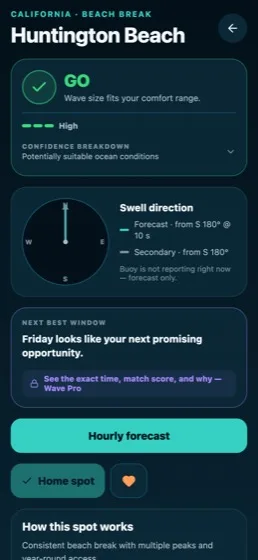
The call, with its reasons
GO, wait, or sit this one out — for your level, at your break. Underneath it: swell direction, how strong the evidence is, and the next window worth planning around.
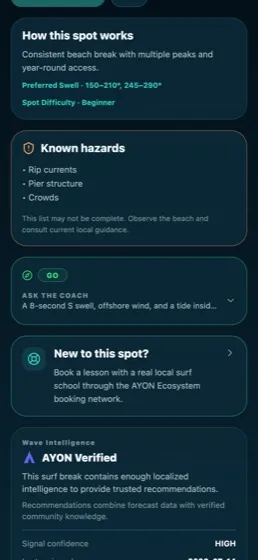
Spot DNA and known hazards
The swell each break accepts, the tide it works on, its difficulty, and the hazards riders report — shown with the honest note that the list may not be complete.
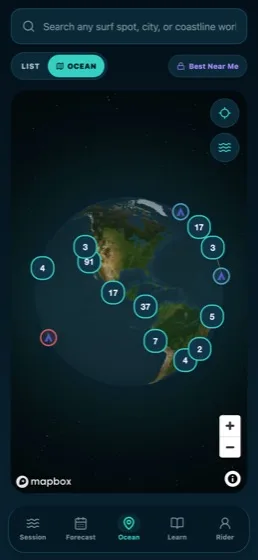
247 curated spots worldwide
Search any coast on the globe. The curated breaks carry a full profile; anywhere else still returns a forecast, clearly labelled as one.
The variables that actually decide a session.
Swell height and period
Height says how big. Period says how much energy is behind it — the difference between a weak windswell and a groundswell that breaks with real force at the same nominal size.
Swell direction vs break exposure
A swell only works if it can actually reach the break. Direction is read against each spot's own exposure window, not as a number in isolation.
Wind, and what it does to the face
Offshore grooms, onshore ruins. Wind is scored against the spot's orientation to say whether the surface will be clean when you get there.
Tide and timing
Many breaks only work on part of the tide. AYON Wave surfaces the window rather than a single instantaneous reading.
Break-specific interpretation
The same conditions produce a different session at a sheltered cove and an exposed beach break. Spot guides carry that local behaviour explicitly.
Ability-level honesty
Conditions are read per level. A day that is excellent for an experienced surfer can be genuinely unsafe for a first-timer, and the app says so rather than averaging it away.
Not all information deserves the same confidence.
This is the part most forecast products leave unstated. AYON Ecosystem separates four kinds of information and never lets one masquerade as another:
- Modeled forecast
- A computed estimate of future conditions. Useful, and never the same thing as an observation.
- Measured
- A directly recorded value — a duration, a timestamp, a sensor reading.
- Detected
- An algorithm flagged a candidate moment. A candidate is a question, not a claim about what happened.
- Verified
- A human reviewed the evidence and confirmed it. Only this earns the word "verified".
Forecast guidance is modeled data and is never a guarantee of safety — the ocean, and your own judgment on the beach, always outrank a model.
Guides that explain what the numbers mean.
What is AYON Wave?
AYON Wave is a surf forecast and decision app for iPhone and Apple Watch. It reads swell height, period, direction, wind and tide for a specific break and turns them into a straight answer about whether and when to paddle out — rather than leaving a rider to interpret raw numbers.
How is AYON Wave different from a normal surf forecast?
A normal forecast reports numbers. AYON Wave interprets them for a specific break and a specific ability level, and it labels where each piece of information came from — modeled forecast, direct measurement, algorithmic detection, or human-verified evidence. Those are never presented as equivalent.
Does AYON Wave work outside Brazil?
Yes. AYON Wave's spot guides cover breaks across the United States, Australia, Mexico and Europe, alongside the Ceará cluster in Brazil, and the forecast engine works from coordinates rather than a fixed region list.
Is AYON Wave free?
AYON Wave is available on the App Store. Pricing and any subscription terms are shown on the App Store listing, which is the authoritative source.
The tab on the right edge of this page? Schools run it too.
That floating live-conditions tab is the AYON Ecosystem widget — the same one running on partner school sites today. It shows live wind and waves for YOUR beach, on your own website, with one line of code. No account, no cost.
Wind and waves are one system.
AYON Wave reads the ocean; AYON Wind reads the air above it. Both sit inside AYON Coastal Intelligence, which is where the two meet.